Things I've built across applications, data, developer tools, and scientific computing. Each write-up explains the problem, my contribution, and the result.
Excubitor carries coding work through fresh model contexts, repeating agreed checks and separate review within fixed limits. Its earlier Python hooks guard specified Git actions.
I built a deterministic checker that compares coding-agent claims with transcript events, returning receipts that identify supporting, contradictory, or missing evidence.
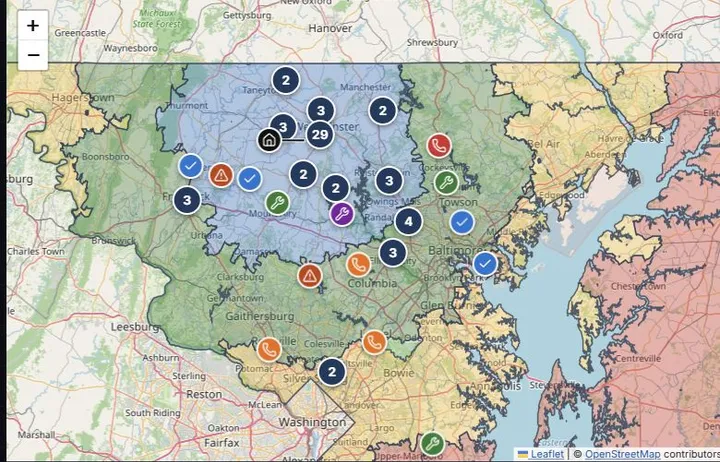
I built a touchscreen customer map with pricing zones, service-due heatmaps, and upsell flags. A septic-services business adopted it to replace its sticker wall map.
I run a Debian homelab and web/mail stack for more than a dozen domains. Correcting DKIM, SPF, DMARC, and reverse DNS restored outbound-mail authentication.
I built a Python photon-transport simulation for a UMBC physics course, then graded other students' implementations as a teaching assistant. Includes an interactive reconstruction.
I rebuilt a file-encryption script as a published Python package, with a CLI, library API, password-derived keys, authenticated encryption, and a versioned file format.
I published a JavaScript plugin adding syntax highlighting and comment shortcuts for 19 languages in Adobe Brackets by integrating existing CodeMirror modes.
I built a private GPT-4 red-teaming experiment, since deleted for security and ethics reasons. John Rodriguez credited the work in his SANS HackFest 2023 talk.
I built an experimental virtual assistant using speech recognition, punctuation restoration, and synthesized speech, with separate experiments in language parsing and facial recognition.
I architected and directed a working voice assistant connecting wake-word detection, speech recognition, language models, MCP tools, and speech synthesis.
I developed a local XTTS-v2 pipeline for audio preparation and voice fine-tuning, producing versioned voice bundles with a pinned synthesis configuration.
I developed a Python router that selects prompt guidance within dependency and context limits, then evaluated structured revision against a baseline in controlled comparisons.
I developed scientific-data ingestion and conversion tools through NASA and UMBC research, including two published Python packages and contributions to collaborative cloud analysis.
Structured career files and primary-source documents support task-directed retrieval and evidence-grounded document generation. The workflow uses file and keyword retrieval rather than a vector database.
A custom language with a lexer, parser, scope checks and Python AST execution, plus TypeScript editor extensions, a language server and a debug adapter for diagnostics, source breakpoints and stack frames. I architected and directed the AI-assisted implementation.
Python experiments with scapy and nmap for network reconnaissance and packet inspection, plus audio-based information hiding and signal processing. I also used Kali Linux and analyzed public password-breach datasets in educational work on owned systems or with consent.
I architected and directed a pre-alpha Rust parser for a documented read-only HDF4 subset, with PyO3/Maturin Python bindings, bounded fuzz targets and differential comparisons. It does not claim complete HDF4 compatibility.
I directed development of a Python tool that parses source ASTs, extracts dependency relationships and generates Mermaid diagrams, with a comparison check for stale diagrams.
I architected and directed a validated DSL-to-Godot authoring pipeline and Python/Blender processing for generated 3D assets. The prototypes use GDScript, procedural geometry and content-addressed artifact storage.
This site uses Astro pages and a PHP inquiry backend with request validation, rate limiting, idempotency and verification checks. I direct its AI-assisted development and review.
A Cython wrapper exposes an existing C scientific routine to Python. The contribution is the integration layer, not authorship of the underlying algorithm.
An independent 2023 investigation used Nmap/Zenmap for service discovery and Telnet for embedded Linux inspection. I imaged SD media and used Disk Drill to inspect recovered files and export a deleted thumbnail.

 Gestalt
 Debian
 Docker
 GitLab